

How to Navigate a High Rate Housing Market
The weekly average 30-year fixed mortgage rate has been sitting above 6% since September 2022 other than one week this past February. As of October 1st, the weekly average for a 30-year fixed was 7.28%. And rates are not likely to have any meaningful decrease over the next few months. So, what can buyers do to combat these higher interest rates?
When you hear about mortgage rates in the news, they are looking at an average. The rate an individual qualifies for varies from person to person and is influenced by a few factors. Some factors are unchangeable, like the fact that investment properties will always carry a higher rate than a primary home. But there are some aspects you can influence. In general, the rate you receive is all about perceived risk and how likely it is you will honor the terms of your loan. Four key aspects are evaluated when examining risk: income, debt, down payment, and credit score. While suddenly increasing your salary would be amazing, that isn’t a realistic expectation. But with a little planning and time, your credit score and down payment are factors you can adjust. What credit score and down payment percentage give you the most favorable terms?
Down Payment
While there are loan options for putting as little as 3% down available, the interest rate offered for these lower down payments are typically higher. The less you put down on a home, the greater the risk for the lender. And when you put less than 20% down, you will have private mortgage insurance (PMI) costs to factor into your monthly housing payment. It is important to note that rather than decreasing steadily for every 1% down, mortgage rates operate on more of a tier basis with certain thresholds offering greater drops in the offered rate.
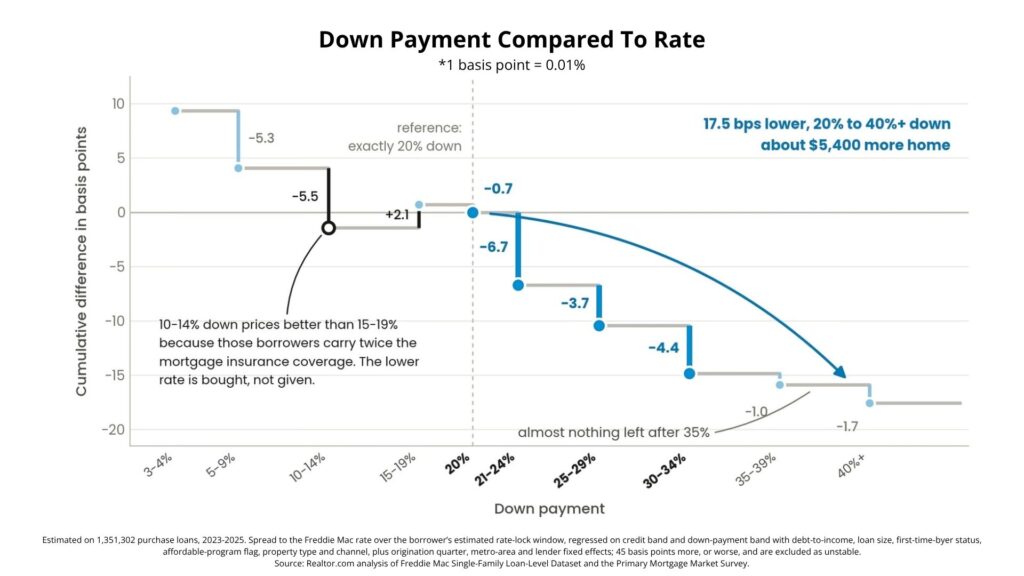
Let’s assume 20% down is not feasible for you. What amount under 20% down would have the greatest impact on your mortgage rate? 10% is a great target for those who don’t have the cash on hand for a 20% down payment. 10% down reduces the rate by 5.5 basis points. (Basis points are a measurement of interest rates used by lenders. 1 basis point is equal to 0.01%) If you have enough funds to put down a little more than 10% but less than 20%, you will likely get more bang for your buck by keeping the down payment at 10% and using the extra cash to pay off debt. It will still help decrease your overall debt-to-income ratio and it could improve your credit score, which may help reduce your rate.
What about 20% down? While there isn’t much difference in rate when increasing the down payment from between 15%-19% to 20%, the elimination of PMI will decrease the overall monthly payment. If you are able to put more than 20% down, you will see additional meaningful rate reductions but this tapers off around 35%.
Credit Score
Your credit score has a major impact on your mortgage. It can be the determining factor in whether you are approved at all. If your credit score does not meet minimum standards for the loan type, then there’s no loan. That’s it. In addition to being a major gatekeeper for loan approval, your credit score plays a major role in what mortgage rate you will be offered. The higher your credit score, the more favorable the mortgage rate available (when keeping all other factors the same).
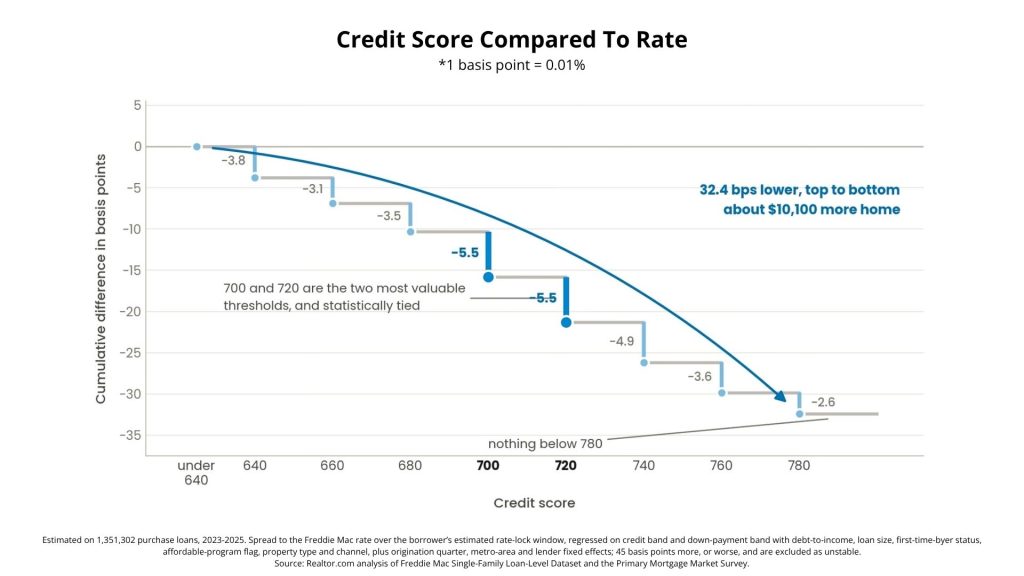
Improving your credit score will arguably have the most noticeable impact on your mortgage rate offered. The biggest drops in available rate occur when increasing the credit score from 680 to 700, 700 to 720, and 720 to 740. Beyond 780, your credit score doesn’t really move the needle on your rate.
Improving your credit score takes time. Depending on your current score and the credit history involved, it can be a matter of a few months to a few years. We have had great luck with credit repair companies helping our clients in situations where their scores were below the minimum requirement and when they were simply aiming to reach top tier rate options. In our experience, 3-6 months of focused credit repair can make a major difference.
Shop Lenders
Not every lender is equal. What types of loans they offer, their qualification requirements, and their rates will vary. Just as you would when hiring a contractor, you should get a few quotes from lenders before making a decision. Ask for a detailed breakdown on rates and fees so that you can clearly see how they differ.
There are hundreds of mortgage lenders out there. Where do you begin?
That’s where we come in! Mortgage brokers do the shopping for you. We take your scenario (location, down payment, credit score, etc.) and match it with the most favorable terms from a wide array of lenders. Different brokers may have access to different lenders, so it is still a good idea to get a few quotes from other brokers. We always recommend potential clients do this by requesting a loan estimate. It is important to note that unless the loan estimate is locked, the rate quoted can change. This can make it very hard to do an apples-to-apples comparison. We pride ourselves on transparency and are happy to do a comprehensive comparison of our loan estimate and another’s. Because the rate isn’t the only factor in determining both up front and monthly mortgage costs, we identify all the differences and how they impact your bottom line. If we’re not the most affordable option, we won’t hesitate to tell you.